Help your team get ahead, and give them a reason to stay.
A novated lease through Positive sits on top of your existing payroll. Your people get a benefit that can leave them better off, and you get a stronger offer for the people you want to keep. We do the setup, at no cost to your business.
No employer feesMinimal payroll work1,500+ employers, from small businesses to governments
Why employers offer it.
A reason to stay
A benefit that can leave your people better off every year, without adding to their pay.
A simple step towards ESG targets.
If you have sustainability commitments, it's a concrete action you can take now. It helps your people switch to electric cars, which can cut the emissions from their commute, and those count towards your Scope 3 footprint.
A benefit people expect
More Australians have a novated lease than ever before, and it's fast becoming a benefit people look for when they choose where to work. Offering it keeps you in the running for the people you want.
Nothing new on your P&L
It doesn't cost your business anything. It changes how part of each person's pay is spent.
The three things we hear most.
Myth
We're too small.
False.
Businesses with just a few staff offer this. You don't need an HR team, just a payroll process.
Myth
It'll create FBT headaches.
False.
Where it's needed, we use the Employee Contribution Method, so your business has no FBT to pay on these leases. We also prepare your annual FBT reporting for you.
Myth
It'll mess with payroll.
False.
It's a few extra lines per employee each pay. Most payroll teams set it up in an afternoon, and the amounts only change when the lease does or a new FBT year starts, on dates we give you upfront.
How it works
What changes in payroll.
Not much. We send your payroll team the exact amounts to deduct, and each pay you pay our invoice. The GST on it goes straight back in your BAS. We look after the finance, the car and the running costs, so you never deal with the lender or the car.
A payroll advice with every deduction, and one invoice for all your leases each pay cycle, with the GST and the total to pay
Visa card setup and management
Insurance, rego, servicing and tyres
Budget reconciliations
End-of-lease options with your employee
You handle
Approve eligible employees, where applicable
Sign each employee's novation agreement
Manage the payroll deductions we provide
Claim the GST credits in your BAS
Lodge your annual FBT return, which we prepare
Let us know if an employee leaves or takes extended unpaid leave
Under $200 a year of your team's time for each employee on a lease. The average employee gets $3,000+ a year in value, compared with paying for the same car and running costs from their after-tax pay.
From sign-off to first lease
Up and running in four quick steps.
Step 1
Say yes
Confirm who's eligible and who we should work with in HR and payroll. A short call is usually all it takes.
Step 2
Payroll setup
One short call with your payroll lead to set up the pay codes. We send the exact deductions, so there's nothing to calculate.
Step 3
Tell your team
We draft the all-staff email. You hit send.
Step 4
First leases underway
Your people get quotes and start leasing, and we look after them from there.
A benefit only works if your people know it’s there.
Many employers start offering novated leasing because one person asked, and then it sits in the background. One lease takes the same setup as ten, so when only a few people use it, you’re getting a fraction of the value. Every extra lease is another person getting ahead, and another reason to stay. Our Employer Playbook has what every team needs to get it in front of everyone and keep it there.
What each team gets
Leadership: a benefit that helps you keep good people, at no cost to the business
HR: an activation pack with a staff microsite, onboarding guides, talk tracks, remuneration review content, emails and posters
Payroll: the exact deductions every pay, with nothing to calculate
Finance: FBT reporting prepared and GST worked out for your BAS
Your people: they deal with us for the whole lease, not with you
We’re members of NALSPA and AFCA, we’re ISO 27001 certified for information security, and we’re independently audited every year to ASAE 3402 by Grant Thornton, in line with state government audit requirements. We work with 1,500+ employers, from small and medium businesses to large corporates, local councils, several state governments and federal departments, and we’re a preferred novated leasing provider to a range of nationally recognised organisations and unions.
How our drivers rate us
4.9
Based on 1,200+ reviews
Luke and the team at Positive Salary Packaging were great to deal with. The finance rate for the novated lease was the best I found and the application was straight forward and seamless. Luke listened to my needs and customised a solution that suited my use of the car. Great customer service and product.
Joel S
The team at positive salary packaging were great to deal with, Especially Tyson, he was fantastic and answered all my questions. Got my lease approved quickly and help secure the car we wanted.
Michael Parigros
Dylan made this easy, couldn’t ask for a better experience
Nickolas P
I received excellent service from Dylan at Positive Salary Packaging. Dylan promptly answered my questions in detail. I appreciated the multiple quote adjustments provided, making it easy to compare my options. They simplified the process.
K
Brittany was exceptional. Negotiated a great price for our car, returned phone calls as soon as she could, and followed through with all paperwork. The entire process was complete within the week. Brittany was brilliant.
Clayton Carnes
Luke Harris was fantastic throughout the entire novated lease process. He was in constant contact, kept me up to date at every stage, and was always contactable whenever I needed help. He was genuinely invested in making sure everything went smoothly.
When complications with the vehicle supplier created an extremely tight deadline, Luke and his team went above and beyond and achieved an amazing result to make it happen. Luke also offered to step in and take over coordination with an aftermarket contractor I had already engaged, giving me some much-needed breathing room while I worked through the leasing paperwork.
It was an amazing experience from start to finish. It genuinely felt like Luke was doing it for me — he wanted to see me get the car, and not once did I feel like I was just another client
Daniel Oakley
I've had two novated leases where Tom Warby was my point of contact on both occasions. He made the process simple, explained everything clearly, and handled it all efficiently. He is very knowledgeable and highly recommended.
Dan E
I'd looked into Novated leasing many times previously but had always found it quite confusing, with pushy sales reps that really put me off.
Tom from the Adelaide office came recommended to me so I decided to chat to him about an EV novated lease. Tom was extremely knowledgeable and was able to explain things clearly for my personal circumstances. The pricing was very good and I felt comfortable progressing.
Tom managed and coordinated everything from there which made the process really easy and I picked up my new EV in October 2025.
I've recommended Tom to many friends since this time, all of whom have had a similar experience.
Overall I'm very happy with the service provided. Thanks!
Jono B
Gave me a quote I couldn't refuse, and turned around the entire process in 2 days! Extremely happy with Luke's service; he explained everything clearly and made novated leasing seamless and efficient.
Kristen Gameau
I had such a wonderful experience with Positive Salary Packaging. Luke was incredibly helpful, patient and professional throughout the entire process.He explained everything clearly, answered all my questions and kept me updated at every stage, which made the whole experience smooth and stress-free.I truly appreciate Luke’s support and would highly recommend him and the Positive Salary Packaging team to anyone considering salary packaging or a novated lease.
Shiney Saini
I had an outstanding experience with Positive Salary Packaging from start to finish. The entire process of arranging my novated lease was handled professionally, efficiently, and with excellent communication every step of the way. What initially seemed like a complicated process was made simple and stress-free thanks to their expertise and willingness to answer all of my questions.
The team was knowledgeable, transparent, and genuinely focused on finding the best solution for my needs. Their customer service was exceptional, and I always felt informed and supported throughout the journey.
I highly recommend Positive Salary Packaging to anyone considering a novated lease or salary packaging. Thank you for making the experience so seamless and enjoyable.
A special thank you to Thomas Warby for your outstanding professionalism, dedication, and support. Your hard work and commitment made all the difference, and I truly appreciate everything you did to help me secure my novated lease and my new car.
Teeraj Tupsy
Great service. Very patient and thorough in answering all my questions and providing many variations on quotes so I could weigh up all the options in length of lease and and different EVs.
Tell us what you need and a lease consultant will reply within one business day.
Get quote
A real quote on the car you are looking at, with every running cost included.
Customise your quote
Update your details to customise the price shown to you.
Hand it to us
Tell us who to talk to. We’ll approach your employer, answer their questions and keep you posted either way. It’s always free for your employer, and you choose whether we mention you.
Give me the simple version
How a novated lease works and why people use one, in plain words. Two minutes, tops.
A smarter way to pay for your car
Picture your pay as a pie. Usually, tax takes its slice first, and your car, fuel and insurance come out of what’s left.
With a novated lease, part of what your car costs comes out of the pie before tax takes its slice. Tax is worked out on a smaller amount, so you pay less of it.
Here’s how it goes:
You pick a car, new or used, or tell us what you want and we’ll find it.
We set up the lease and one budget for the car and its running costs.
Your employer takes the payments out of your pay and sends them to us.
You fuel up or charge with your Visa card, and we pay the other bills.
When the lease ends, you decide what happens next.
Why people do it
You pay less income tax: if you earn between $45,000 and $135,000, every dollar that goes to your car before tax saves you about 32 cents. You save the GST, the 10% tax on things you buy, on the car’s price (up to a limit) and on running costs like fuel and servicing. And one team looks after the bills, the budget and anything that comes up, for as long as you have the car.
Put together, that can leave you better off than paying for your car another way. How far ahead depends on your pay and the car, so your quote shows the two side by side.
Who does what
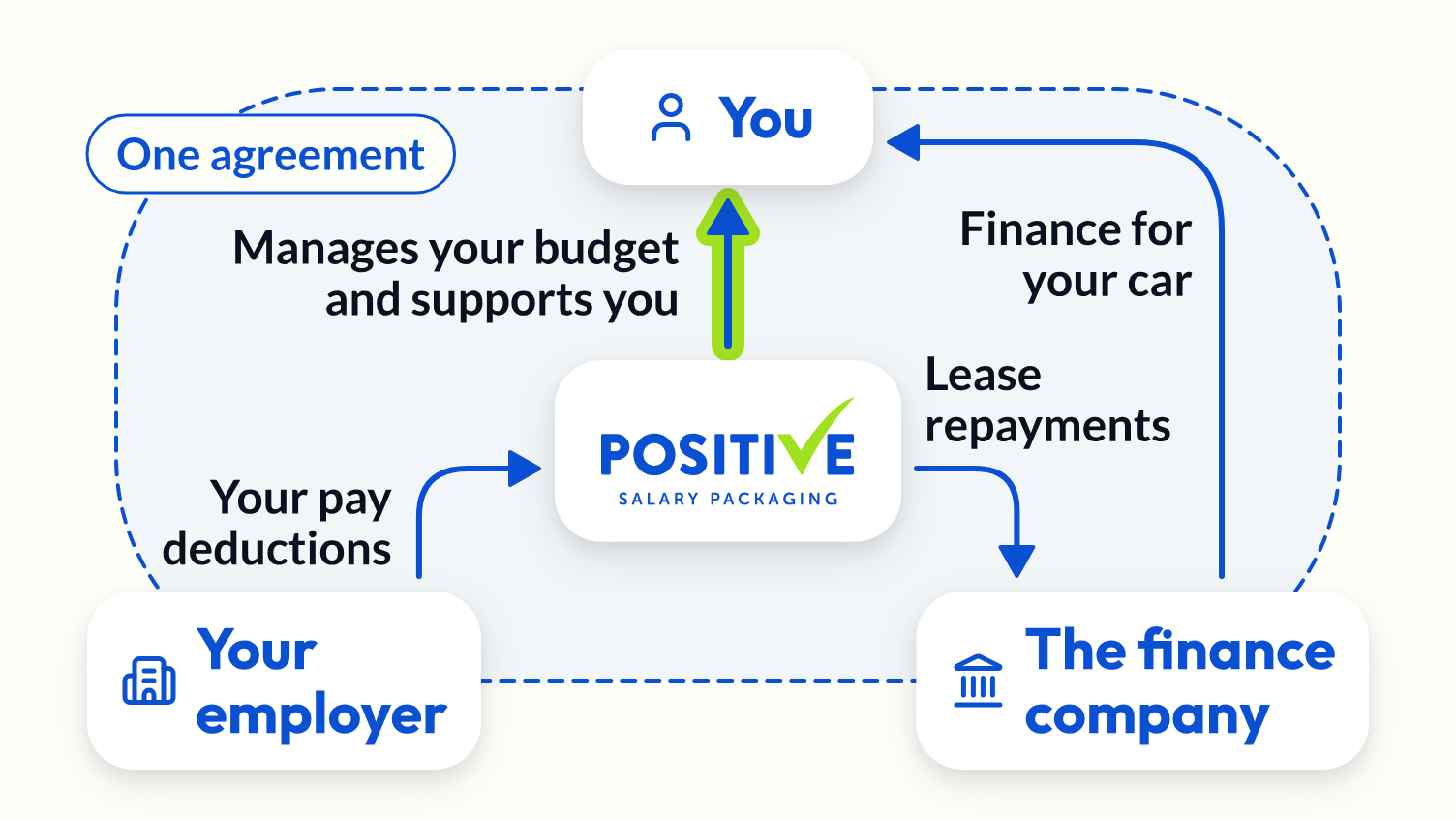
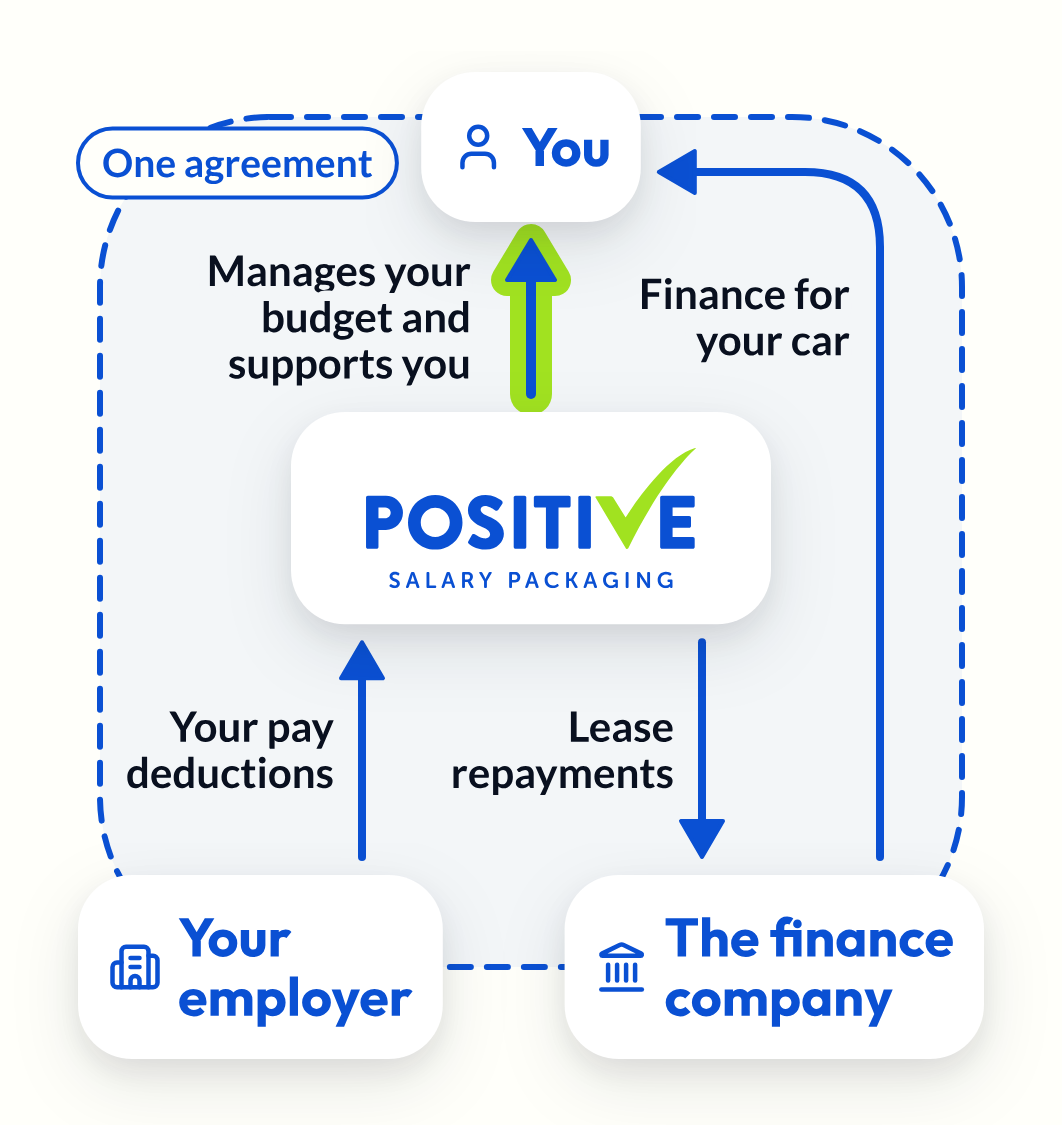
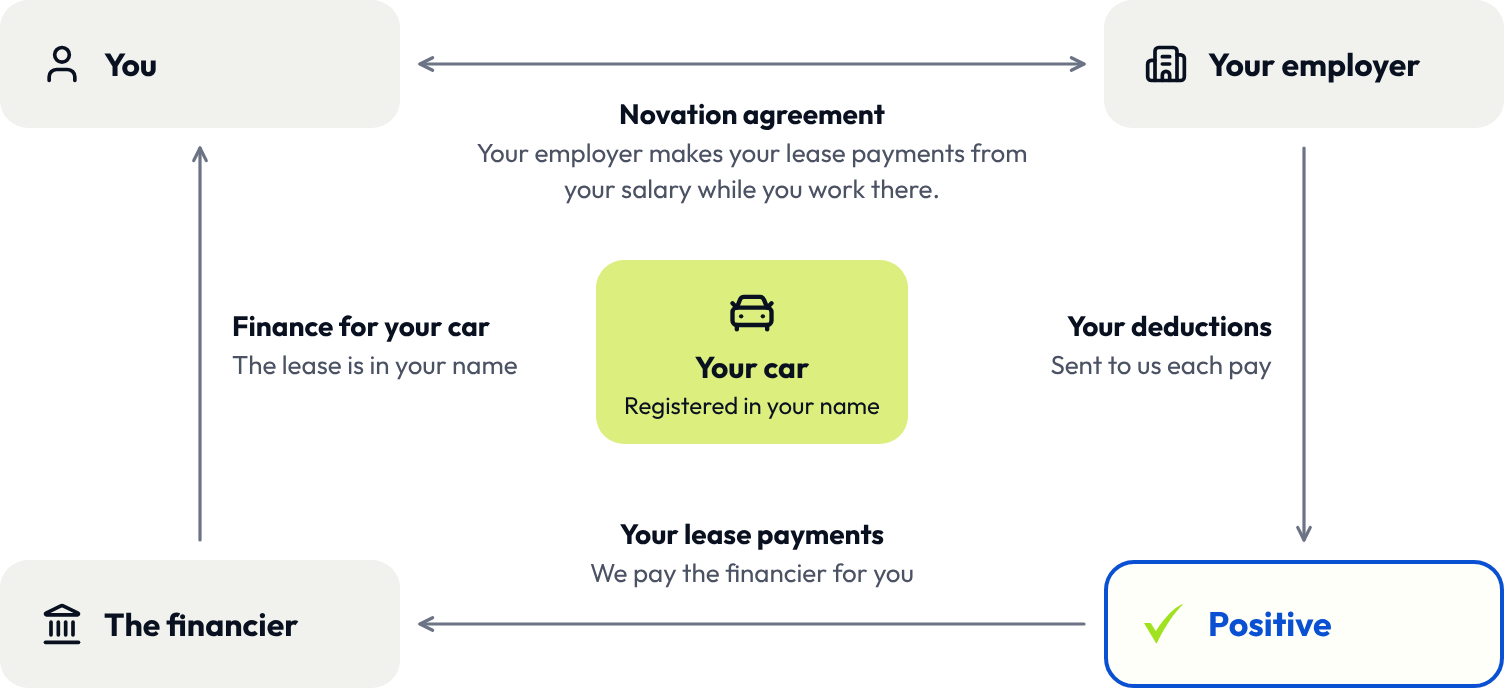
“Novated” is a fancy word for an agreement between you, your employer and the finance company. We set it up and look after it, so you only ever deal with us.
You Pick the car and drive it.
Positive We set it all up, pay the bills and help whenever you need us.
Your employer Takes the payments out of your pay and sends them to us.
The finance company Puts up the money for your car. We deal with them for you.
What’s included
Your car
The lease repayments.
Fuel & charging
A Visa card that works almost anywhere.
Insurance
Use your own insurer, or ours. Your call.
Rego
Paid when it’s due.
Servicing
Regular services, already budgeted for.
Tyres
Worn out or blown, new ones are already budgeted for.
Finding the car
Tell us what you want. We’ll find it.
Help
With you for the whole drive.
Luke was incredibly easy to talk to and always took the time to answer my questions, making what could have been a confusing process feel straightforward and stress-free.
Lauren SGoogle review
The questions people ask first
Plain-English answer here, two or three short paragraphs. Avoids hedging, uses real numbers, qualifies in fine print rather than mid-sentence.
Plain-English answer here, two or three short paragraphs. Avoids hedging, uses real numbers, qualifies in fine print rather than mid-sentence.
Plain-English answer here, two or three short paragraphs. Avoids hedging, uses real numbers, qualifies in fine print rather than mid-sentence.
Plain-English answer here, two or three short paragraphs. Avoids hedging, uses real numbers, qualifies in fine print rather than mid-sentence.
Plain-English answer here, two or three short paragraphs. Avoids hedging, uses real numbers, qualifies in fine print rather than mid-sentence.
Plain-English answer here, two or three short paragraphs. Avoids hedging, uses real numbers, qualifies in fine print rather than mid-sentence.
For anyone who likes to check the working. Every moving part of a novated lease, from tax to the residual value.
How the money moves
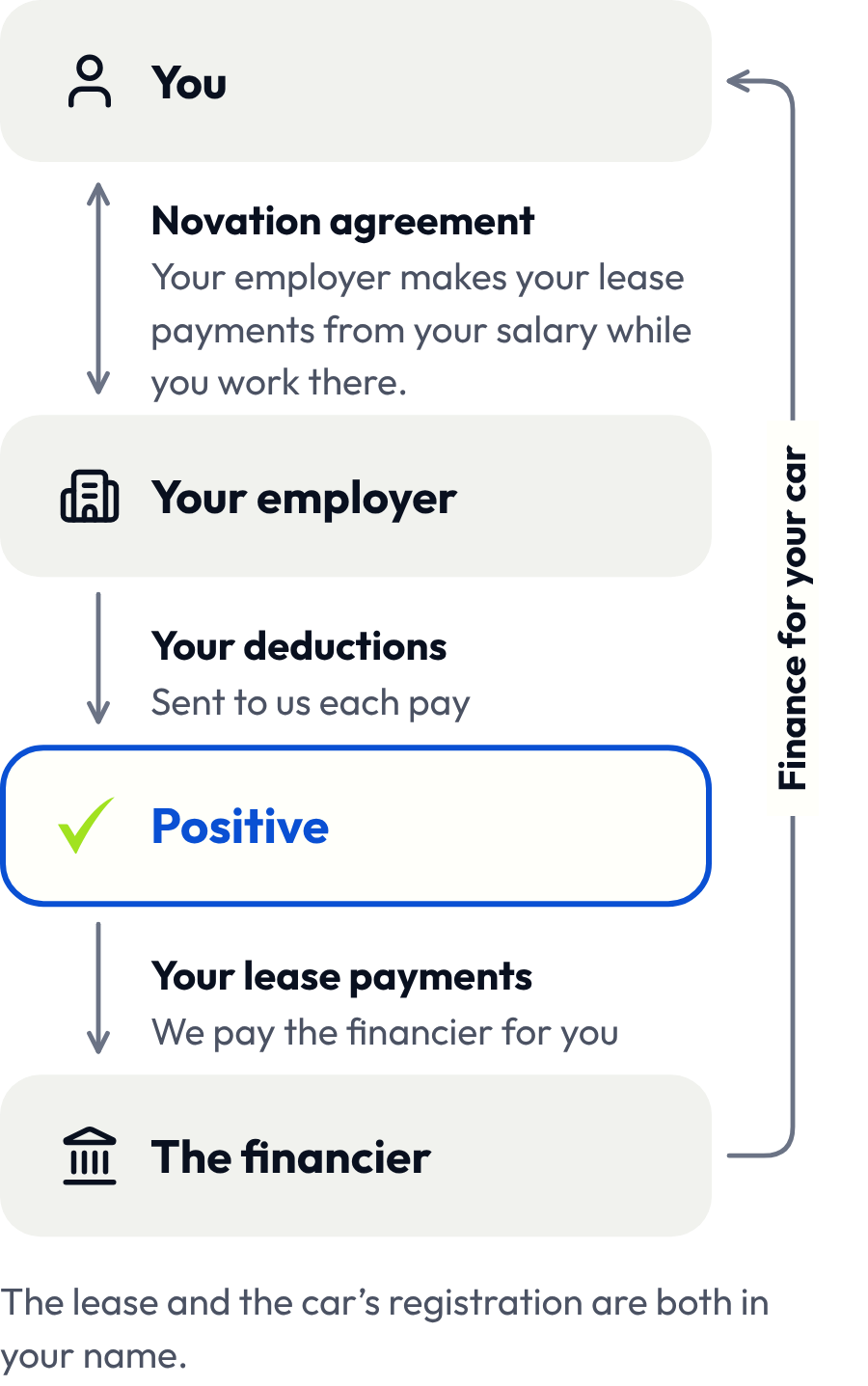
A novated lease is an agreement between you, your employer and a financier, who provides the finance for your car. Your employer agrees to make the lease payments out of your salary while you work there, and we manage the lease, the budget and the bills.
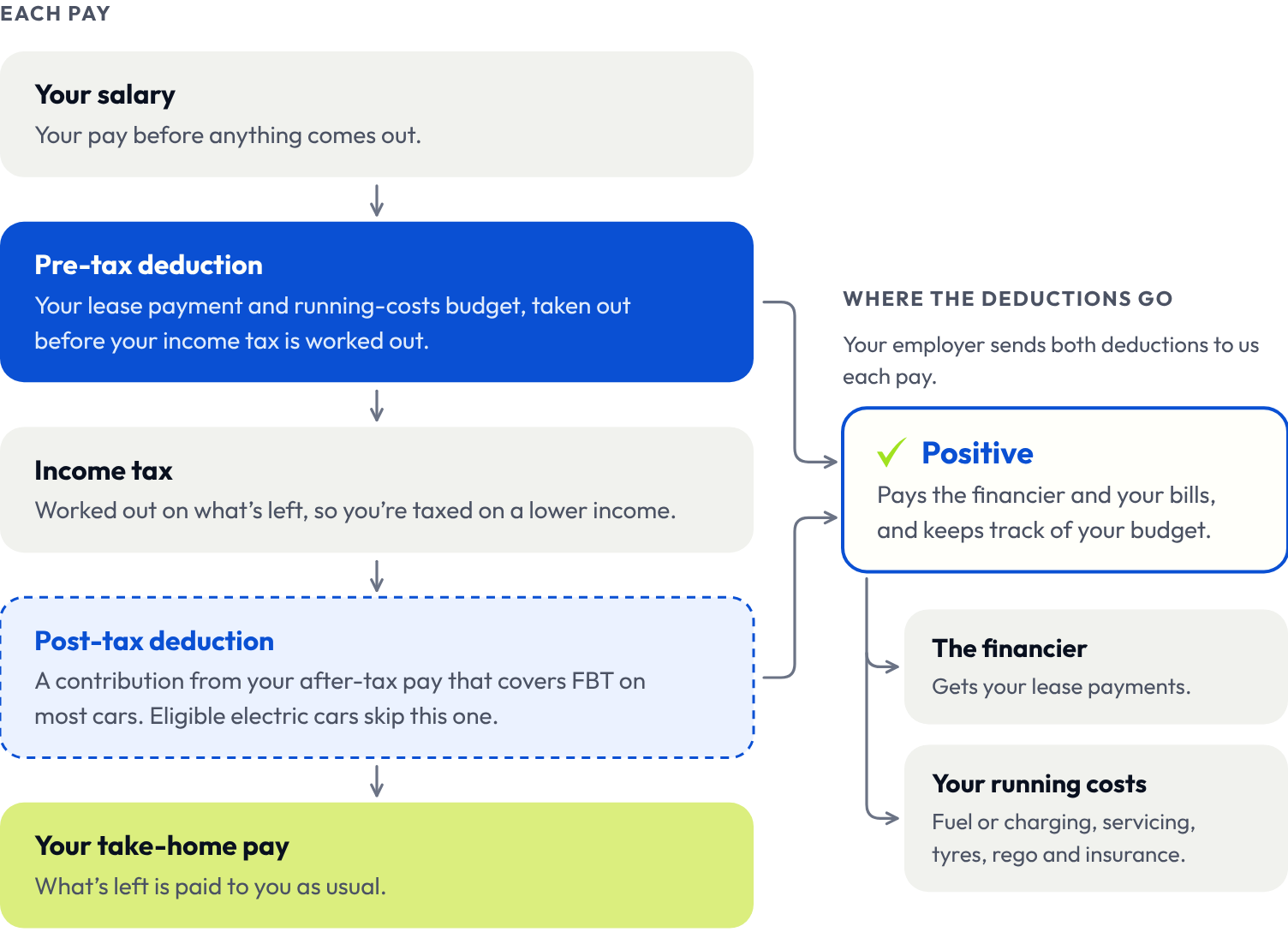
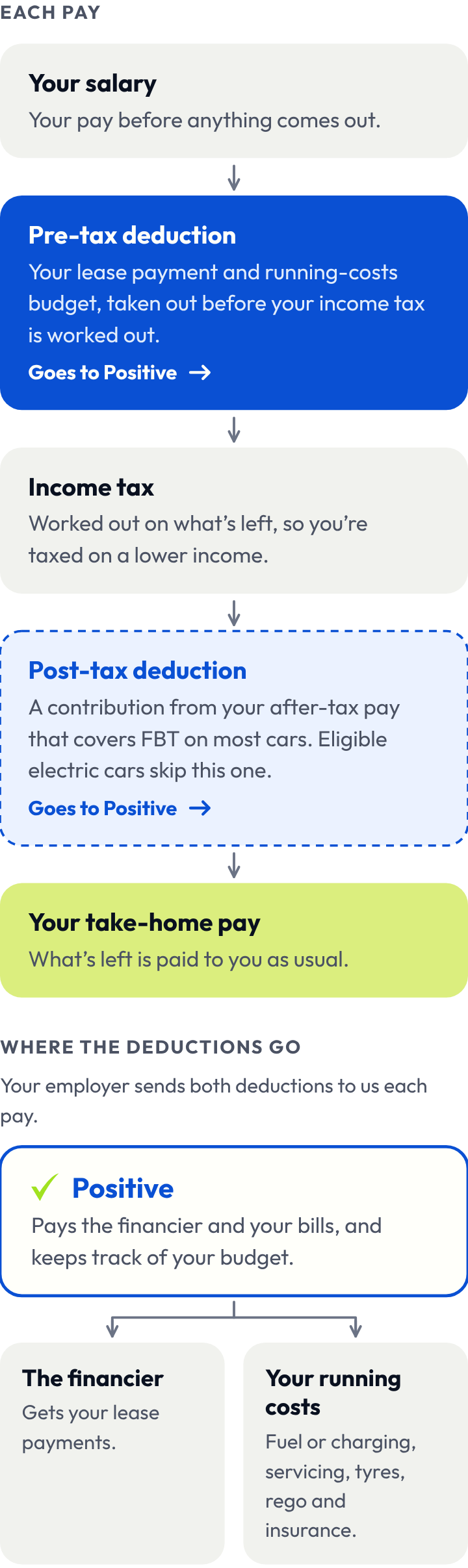
Each pay, your employer makes up to two deductions and sends them to us:
Pre-tax deduction. Your lease payment and a budget for running costs, taken out before your income tax is worked out.
Post-tax deduction. A contribution from your after-tax pay that covers fringe benefits tax (FBT) on most cars. Eligible electric cars skip this one.
We pay the financier and the bills from those deductions. Fuel goes on your Visa card, which draws straight from your budget. With an EV, you either use the card for public charging or, if you mostly charge at home, we cover your charging at the ATO’s home charging rate instead. Lease terms run from one to five years, and you choose the term, the car and the budget.
Four parties, one agreement
The novation agreement hands your lease payments to your employer while you work there. If you leave, they pass back to you until a new employer takes them on or the lease is paid out.
You Choose the car, the term and the budget. The car is yours to drive, for work and privately.
Positive Arranges the finance, sets your budget, pays the bills, processes claims and works out your deductions with payroll.
Your employer Signs the novation agreement, makes your deductions each pay and sends them to us. There’s no FBT for them to pay.
The financier Provides the finance for your car and is paid from your deductions. We deal with them directly. On paper, they own the car until the residual value is paid.
How the income tax saving works
Your pre-tax deduction comes out before income tax is calculated, so you’re taxed on a lower income. Each pre-tax dollar saves tax at your marginal rate: the rate you pay on the last dollar you earn.
In 2026–27, everyone earning between $45,001 and $135,000 has the same marginal rate: 30%, plus the 2% Medicare levy. A nurse on $75,000 and a manager on $130,000 both save 32 cents on each pre-tax dollar, as long as the deduction keeps them in that bracket.
The saving per dollar is higher above $135,000 and lower below $45,000. Your quote works it out on your actual salary.
Fringe benefits tax, step by step
A car your employer provides for private use is a fringe benefit. Fringe benefits tax (FBT) is charged to the employer at 47%, based on the benefit’s taxable value. A novated lease is set up so that value comes to zero. Here’s how.
The statutory formula method
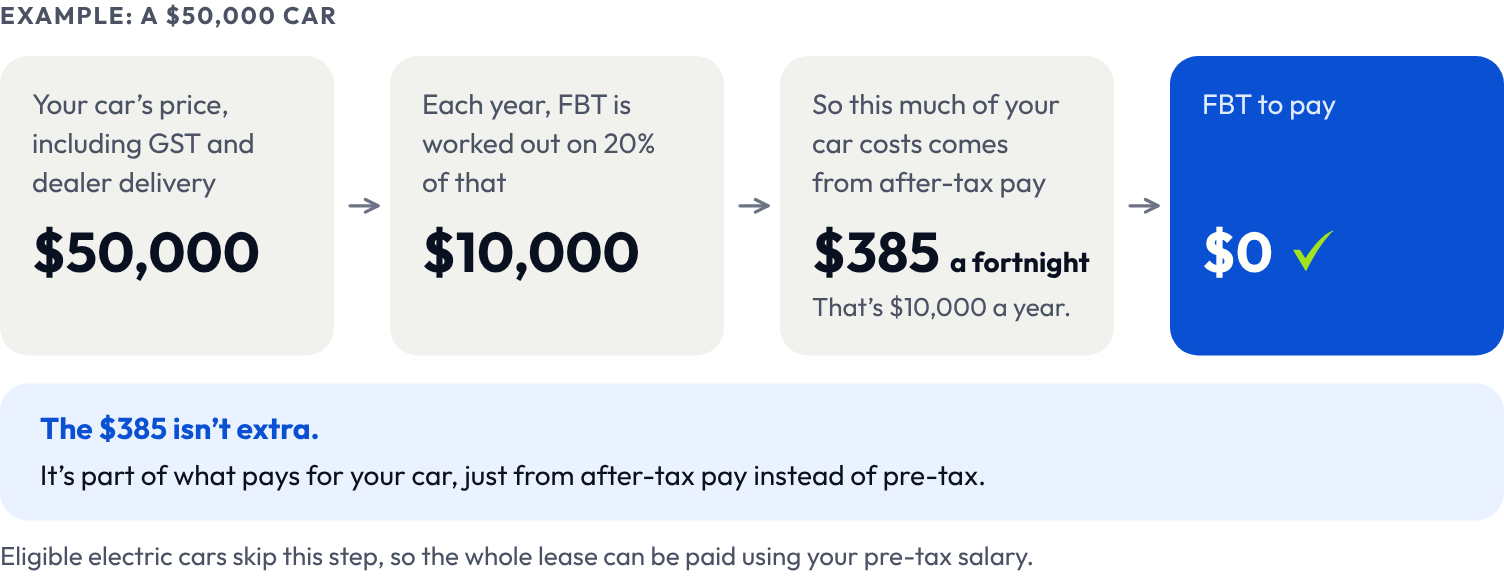
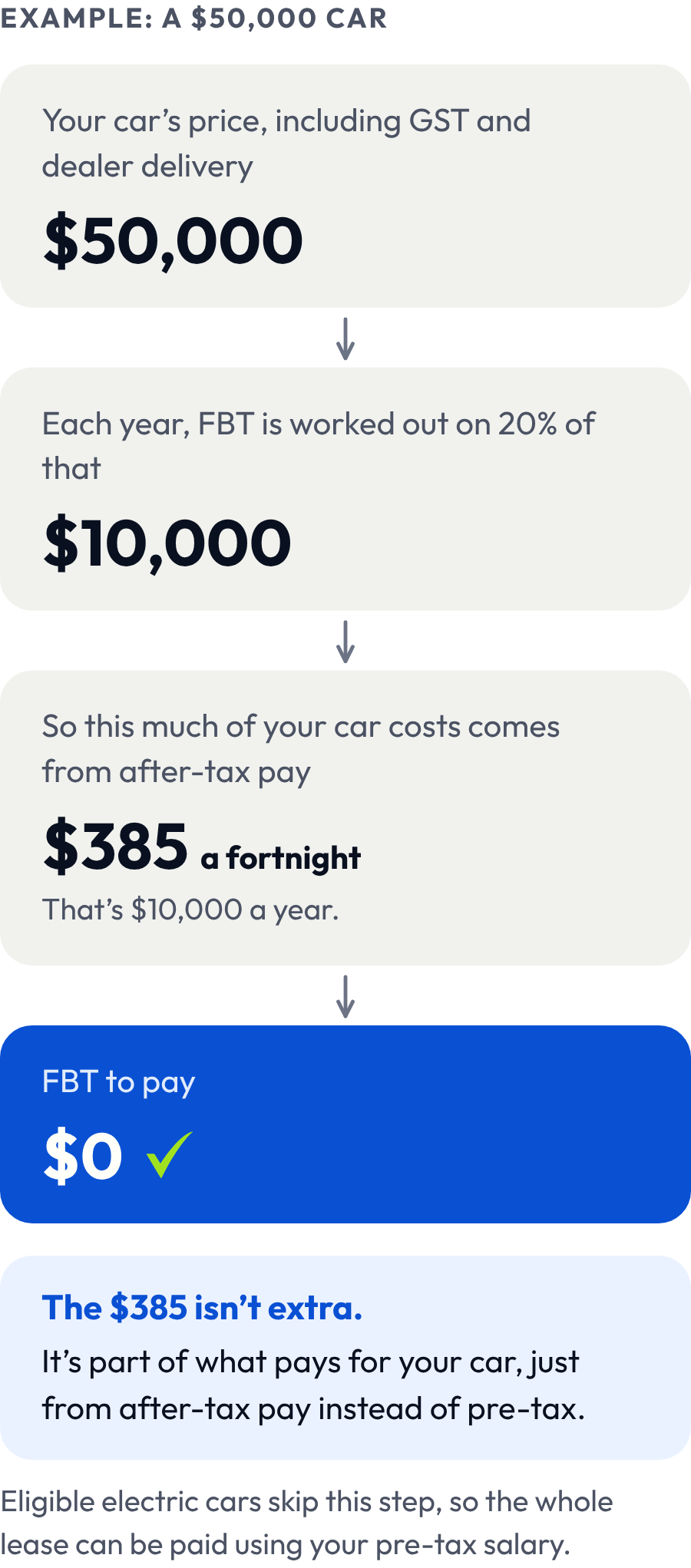
Most leases use this one. The taxable value is 20% of the car’s base value each year, however far you drive. The base value is what the car cost including GST and dealer delivery, but not rego or stamp duty. On a $50,000 car, that’s a taxable value of $10,000 a year.
The employee contribution method (ECM)
To cancel out the FBT, you pay the taxable value from your after-tax pay: $10,000 a year in this example, or about $385 a fortnight. Every dollar you contribute lowers the taxable value by a dollar, so the FBT comes to zero.
That contribution is part of what pays for your car and its running costs, so it isn’t an extra cost on top. It’s the share paid from after-tax pay, and your quote shows both deductions so you can see the split.
The operating cost method (OCM)
If you drive a lot for work, this method can shrink the post-tax contribution. The taxable value is the car’s total costs for the year, lease payments included, multiplied by the share of your driving that’s private. You’ll need a logbook kept for 12 continuous weeks to show your work use, and it can stand for up to five years. Your employer chooses the method, and we’ll show you whether it’s worth it.
Eligible electric cars are exempt from FBT under the Electric Car Discount. With the FBT exempt, the post-tax contribution falls away, and the whole lease, running costs included, can be paid using your pre-tax salary.
A car qualifies if it’s:
battery electric or hydrogen fuel cell (plug-in hybrids stopped qualifying for new leases from 1 April 2025)
first held and used on or after 1 July 2022
priced below the luxury car tax threshold for fuel-efficient cars when first sold: $91,661 for cars first sold in 2026–27
Reportable fringe benefits
Even with the exemption, the benefit appears on your income statement as a reportable fringe benefit. On a $50,000 electric car, that’s about $18,870 a year. You aren’t taxed on it, but some income tests count it, including HELP repayments, the Medicare levy surcharge, the private health insurance rebate, family payments and child support.
If that matters for you, we’ll show you how a post-tax contribution can lower the reportable amount.
Changes from 1 April 2027
The government plans to change the Electric Car Discount, and what applies depends on when you commit to your lease. Under the bill, a lease committed before 1 April 2027 keeps the full exemption for as long as it runs. From 1 April 2027, cars valued at $75,000 or less still get the full exemption for the life of the lease, and those above $75,000, up to the luxury car tax threshold, get a 25% FBT discount instead. New leases from 1 April 2029 get the 25% discount. Refinancing, changing the term or residual value, adding accessories that raise your payments, or moving to a new employer counts as a new commitment. Your reportable fringe benefit stays at full value either way. The bill passed the House of Representatives in October 2026 and still needs the Senate.
The financier claims back the GST on the car’s purchase price, so you don’t finance it. That saving is capped at one-eleventh of the ATO’s car limit: $6,353 for a car first used in 2026–27.
On running costs like fuel, servicing, tyres and insurance, your employer claims the GST back and the saving flows into your budget. Rego is GST-free, so it costs the same either way.
The residual value, and your options at the end
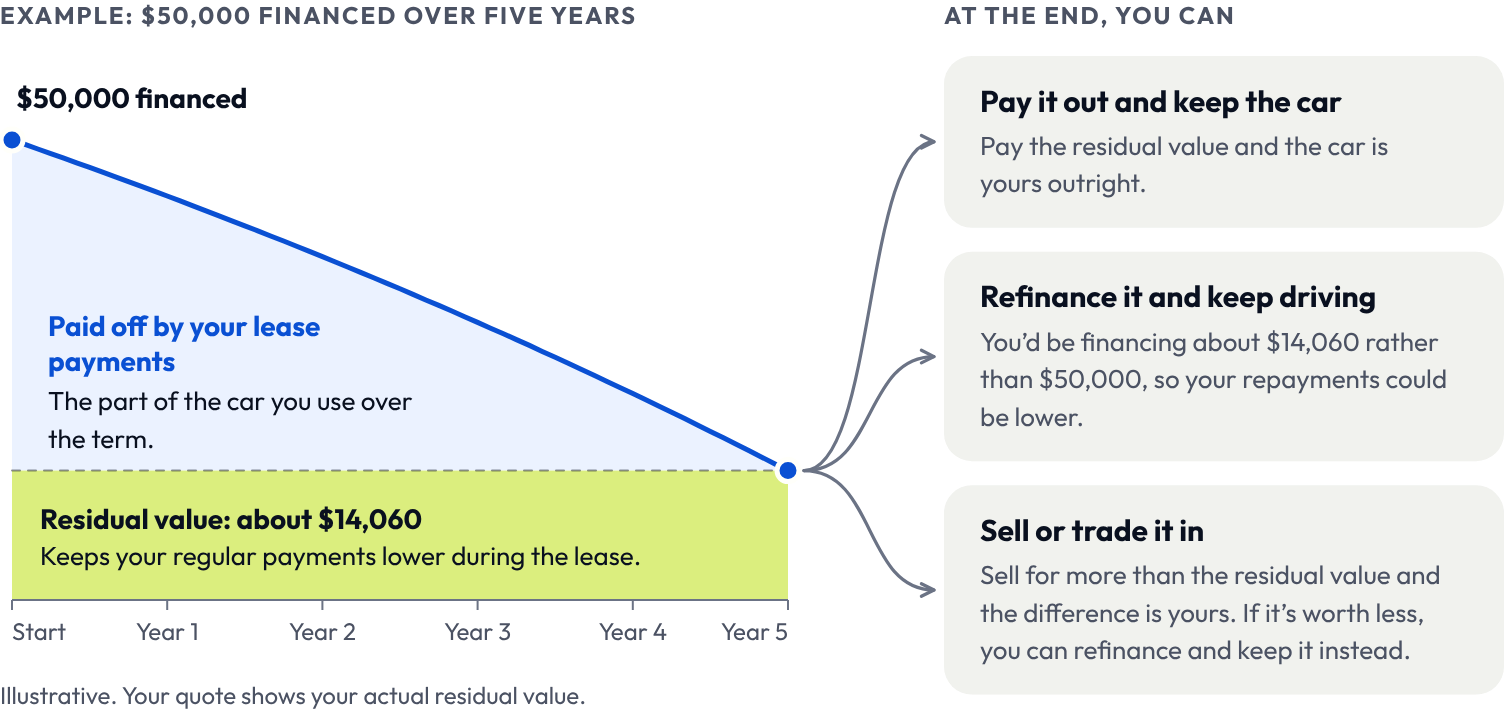
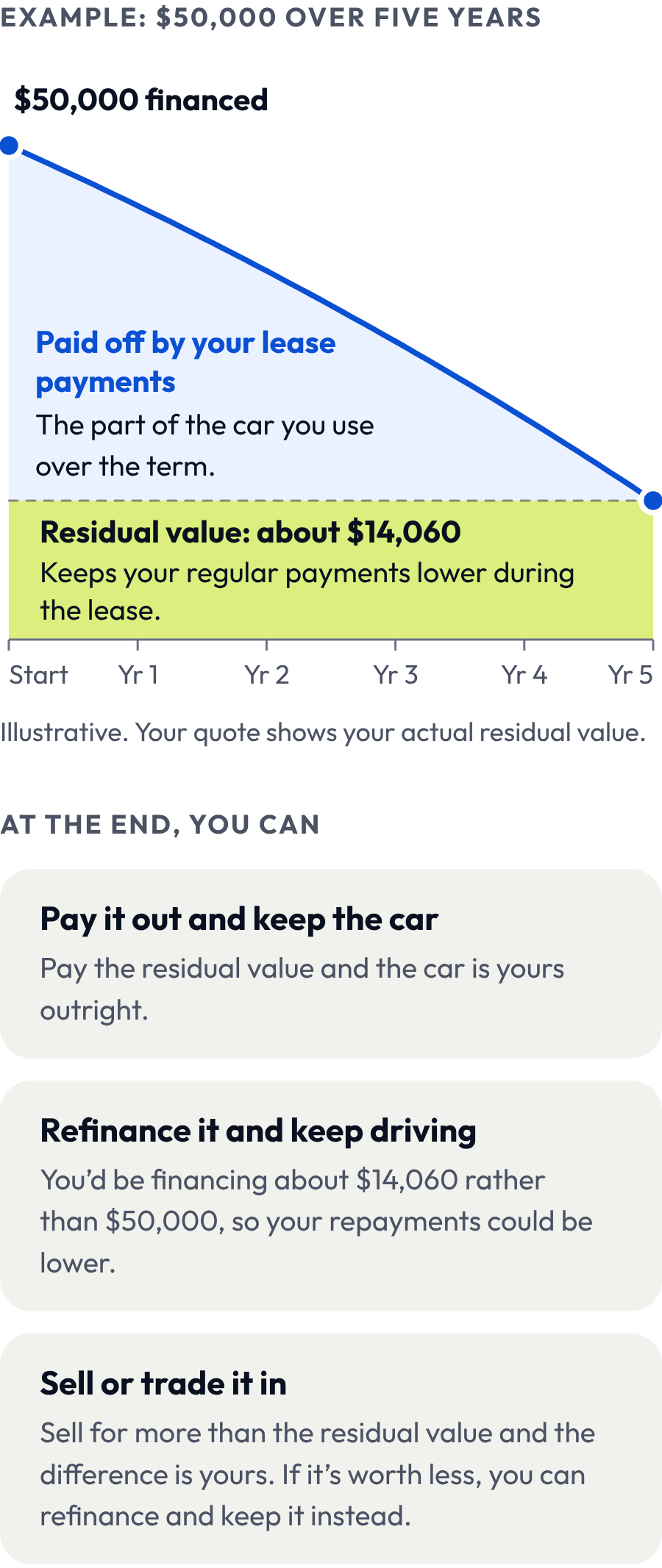
The residual value is the amount left on the lease at the end of the term. It’s there because a lease pays for the part of the car you use over the term, not the whole car. The ATO expects the residual value to reflect what the car is likely to be worth when the lease ends, and sets a minimum for each term. If the lease paid off the whole car, the ATO would treat it as buying the car on finance rather than leasing it, and the payments wouldn’t count as lease payments. That’s what makes a novated lease a lease rather than a loan.
Minimum residual value by term, as a share of the amount financed:
1 year: 65.63%
2 years: 56.25%
3 years: 46.88%
4 years: 37.50%
5 years: 28.13%
On $50,000 financed over five years, the minimum residual value is about $14,060.
At the end, you can pay it out and keep the car, refinance it and keep driving, or sell or trade in the car. Sell for more than the residual value and the difference is yours. If the car is worth less, you can refinance and keep driving, so a shortfall only becomes a loss if you choose to sell.
Some insurance policies include gap cover, also called guaranteed asset protection or total loss cover. If the car is written off during the lease, your insurer’s payout can be less than what’s left on the lease, and gap cover pays the difference.
Your quote shows the residual value up front, and we’ll contact you from around nine months before the lease ends to go through your options.
How it compares
A novated lease, a car loan and a business operating lease can all put you in the same car. The differences are whose name it’s in, how it’s paid for and what happens at the end.
Novated lease
The car is registered in your name, the lease is in your name, and it’s yours to drive for private and business use. On paper, the financier owns it until the residual value is paid. The lease and running costs are paid using your pre-tax salary, with any FBT contribution from your after-tax pay. You save the GST on the purchase price, up to the car limit, and on running costs. At the end you pay the residual value and keep the car, refinance it, or sell or trade it in. If you sell the car for more than the residual value, the difference is yours, tax-free. If it’s worth less, selling would leave a shortfall for you to pay, so you might refinance the residual value and keep the car instead.
Car loan
You own the car from day one, and the lender holds it as security until the loan is repaid. Repayments and running costs come out of your after-tax pay, with GST included in both. Some loans end with a balloon payment; otherwise the car is yours outright once the loan is paid off. If the car is worth more or less than you owe, that difference is yours too.
Business operating lease
A business leases the car from a leasing company, which owns it throughout. The business pays the lease and running costs and claims them as business expenses, and if an employee drives it privately, the business usually pays FBT on that use. At the end, the car goes back to the leasing company with no residual value to pay, and the leasing company carries the resale risk, usually with limits on kilometres and wear. It’s how businesses run company and fleet cars, rather than something you take out yourself.
Where the confusion comes from. If you’ve heard that with a novated lease you never own the car, or that it goes back at the end, that’s usually a business operating lease being described. With a novated lease, the car is in your name, and at the end you can pay the residual value and keep it.
Your quote shows how a novated lease compares with paying for the same car and its running costs from your after-tax pay, over the same term.
How your budget works
Your running costs budget isn’t a fee or a charge. It’s your money, held on your behalf to pay for running your car. Keeping it accurately managed is how you get the most from the GST and pre-tax savings on those costs.
We estimate a year of running costs, like fuel or charging, servicing, tyres, rego and insurance, and spread them across your pays. Insurance is your choice: keep your own insurer or take cover through us. Fuel goes on your Visa card. With an EV, you choose how charging is covered: use the Visa card for public charging, or, if you mostly charge at home, we cover your charging at the ATO’s home charging rate instead. For other costs, we pay the supplier directly on your behalf or reimburse you when you send us the receipt.
We’ll review your budget as you go and adjust it if your driving or prices shift, telling you first or taking guidance from you. If your budget builds up more than you need, you can ask for the extra back at any time, and anything left over when the lease ends comes back to you too. Either way, it’s paid through your employer’s payroll, so it’s taxed as income.
When life changes
Your salary changes. Your deductions stay the same, but the tax effect moves with your marginal rate. Tell us and we’ll re-run your numbers.
You change jobs. If your new employer agrees, the lease moves with you under a new novation agreement. Otherwise it passes back to you, and you pay it from your after-tax pay or pay it out. We’ll handle the paperwork either way.
Electric and plug-in hybrid cars. Some changes count as a new commitment and can change your car’s FBT treatment. For a plug-in hybrid leased before 1 April 2025 that’s still exempt, the exemption ends from the date of the change and can’t be regained. That includes a new employer (even within the same group of companies), a break in your novation such as unpaid leave, or a change to your payments or residual value, including accessories that change them. For an electric car, under the bill, refinancing, changing your term or residual value, adding accessories that raise your payments, or moving to a new employer is treated as a new lease, so the rules on that date apply: the full exemption until 31 March 2027, then the full exemption only for cars valued at $75,000 or less (a 25% discount above that), and the 25% discount for all electric cars from 1 April 2029. We’ll check before you make any change.
Unpaid or extended leave. Your deductions pause with your pay, so you’d make the lease payments directly in the meantime. Talk to us just before you go and we’ll set it up with your employer.
An accident. Call us. We’ll help with the insurance claim, and your insurance excess can be paid from your budget too.
When to take a closer look
A novated lease tends to work best when you’re replacing a car you’d buy anyway, your work is steady and you plan to keep the car for the term. It’s worth a closer look if:
your job is likely to change soon
the weekly cost would stretch your budget
you have high-interest debt to pay down first
you’re about to apply for a home loan, since lenders count the lease payments
We’ll show you how it compares with your other options. Your call.
Tyson was knowledgeable, professional and very helpful. Not only did he answer all my questions but he supplied a very complete quote and made sure that I understood the leasing conditions and process.
Elizabeth DGoogle review
The detailed questions
Plain-English answer here, two or three short paragraphs. Avoids hedging, uses real numbers, qualifies in fine print rather than mid-sentence.
Plain-English answer here, two or three short paragraphs. Avoids hedging, uses real numbers, qualifies in fine print rather than mid-sentence.
Plain-English answer here, two or three short paragraphs. Avoids hedging, uses real numbers, qualifies in fine print rather than mid-sentence.
Plain-English answer here, two or three short paragraphs. Avoids hedging, uses real numbers, qualifies in fine print rather than mid-sentence.
Plain-English answer here, two or three short paragraphs. Avoids hedging, uses real numbers, qualifies in fine print rather than mid-sentence.
Nine quick questions. We’ll match you against every new car on our list and show what each would cost a week on a novated lease, running costs included.
Tell us who your employer is and who handles payroll. We contact them, explain the arrangement, and send them the one page they need to sign.
You do not have to raise it yourself, and we will not use your name if you would rather we did not.
The payroll lines, in full
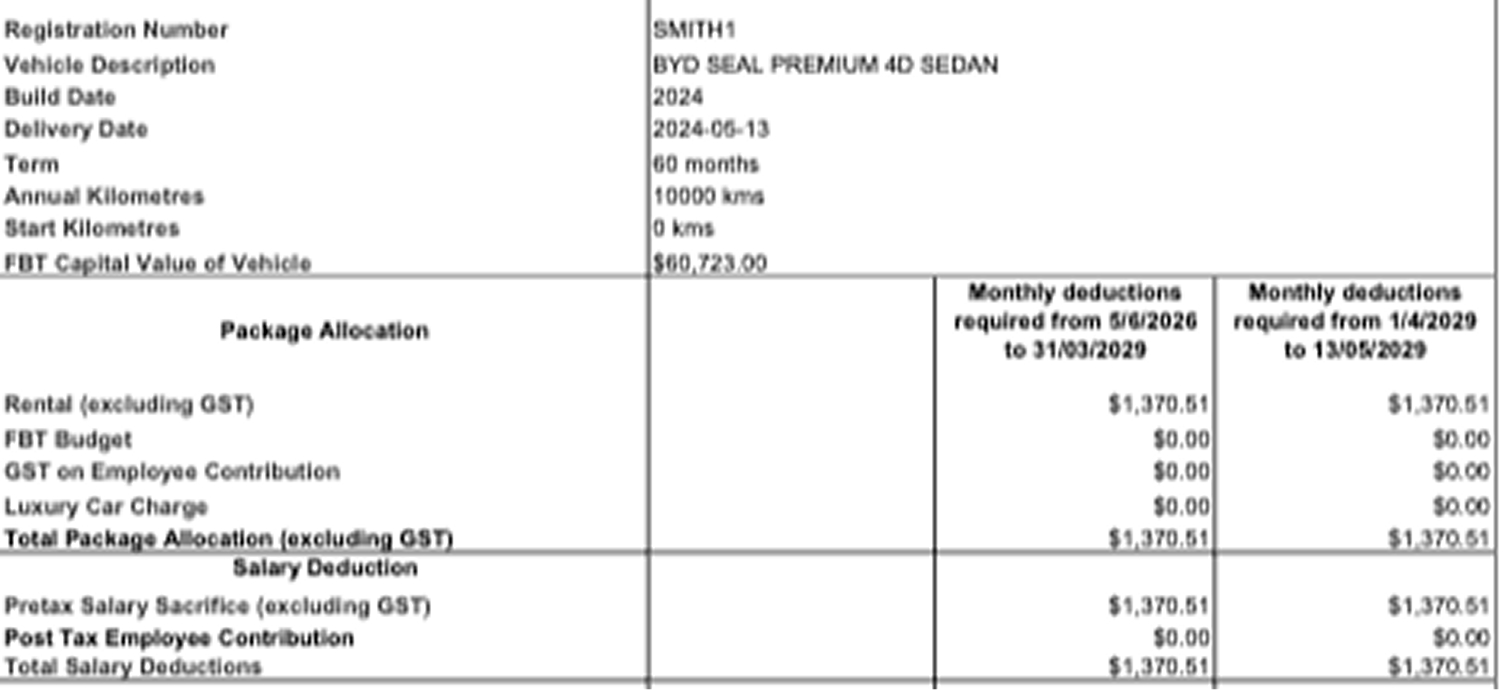
For one employee on a $74,990 vehicle, your fortnightly payroll run gains exactly two lines:
Pre-tax deduction — the lease and running costs, taken before tax is calculated.
Post-tax deduction — the Employee Contribution Method amount, which is what keeps your FBT exposure at exactly $0.
We invoice you for the total fortnightly. You forward it. Nothing else about your payroll changes, and the ATO position is documented for you.
See all assumptions
Figures shown are indicative only and based on standard assumptions current as at November 2026. They do not constitute a quote or financial advice. Your actual cost depends on your income, the vehicle, your annual kilometres and the finance terms offered.